
Millipedes
Small, black, shiny "worms" crawling across the terrace, up the walls and under the door after the first autumn rain: in Cyprus they are often called black worms or moisture worms (μαύρα σκουλήκια της υγρασίας). They are millipedes, and in some weeks of the year they arrive in their hundreds.
What are they?
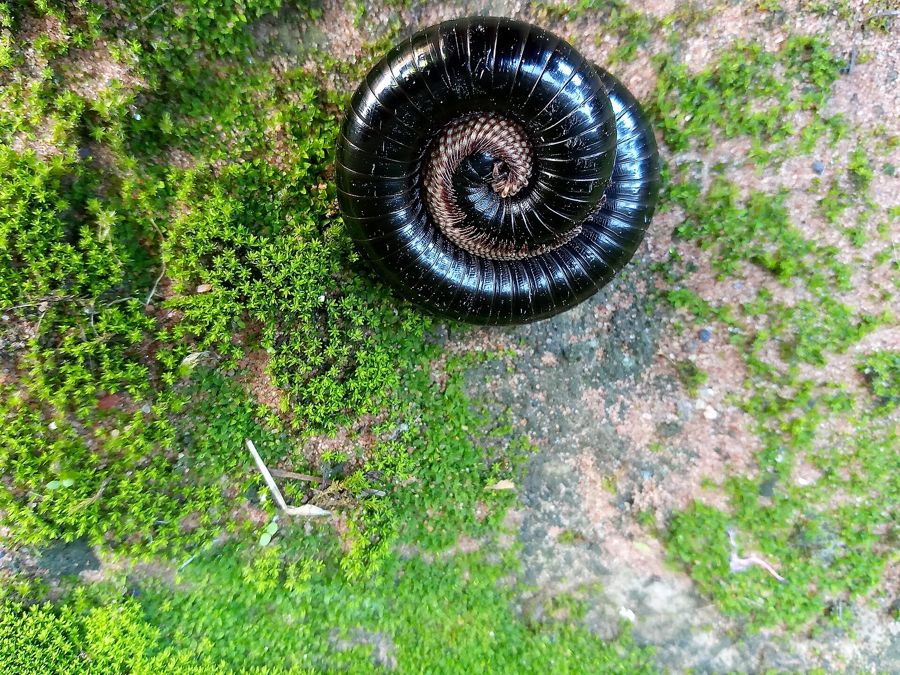
Millipedes are not worms and not insects. They belong to their own group of arthropods, the Diplopoda, which means "double legs": each body segment carries two pairs of legs. The ones we meet around Paphos homes are usually dark brown to black, glossy and cylindrical, about 2 to 4 cm long, and they curl into a tight coil when touched.
Outdoors they are useful. They live in damp soil, leaf litter, mulch and under stones and logs, where they feed on decaying plant material and help turn it back into soil. The trouble starts when the conditions push large numbers of them towards your house.
GroupArthropods, class Diplopoda
SizeUsually 2 to 4 cm
ColourDark brown to black, glossy
LegsTwo pairs on each body segment
ActiveAt night, in damp weather
Peak seasonAutumn rains and spring
Why do they come into the house?
Millipedes need moisture to survive. Heavy rain floods the soil they live in, and long dry spells dry it out; either way they leave it and wander, mostly at night. Walls, paved patios and terraces are the first obstacle they meet, so they climb and spread across them and slip in under doors, through gaps around frames and pipes, through weep holes and via drains.
Inside a dry home they cannot survive for long. That is why the typical sign is not a living colony but dozens of coiled, dead millipedes near doors, in bathrooms, on the ground floor and in storerooms each morning.
Are they dangerous?
- They do not bite or sting, and they do not damage the building, furniture, clothes or food.
- They can stain and irritate. When crushed or handled, many species release a defensive fluid that can leave brown marks on light floors and grout and may irritate skin or eyes. Sweep or vacuum them up rather than stepping on them, and wash your hands if you touch one.
- Pets and children: a pet that bites one may drool or vomit briefly because of the bad taste and the fluid. Contact your vet if symptoms continue.
- In the garden, very large numbers can nibble seedlings, soft fruit and vegetables lying on damp soil.
So millipedes are a nuisance rather than a health risk, but a few hundred a night on a terrace or in a hotel corridor is more than most people want to live with.
Millipede or centipede?
| Millipede | Centipede | |
|---|---|---|
| Legs | Two pairs per segment, many short legs | One pair per segment, long legs |
| Body | Rounded, like a tube | Flat |
| Movement | Slow, curls up when disturbed | Fast, runs away |
| Bite | No | Yes, can bite |
| Diet | Rotting plant material | Other insects |
How ProPest deals with millipedes
- Inspection. We look at where they are breeding and how they are getting in: damp beds against the walls, mulch and leaf litter, downpipes emptying at the foundation, leaking taps, gaps under doors and around frames.
- Perimeter treatment. Our technicians treat a band around the building: along the foundation and outer walls, door thresholds, paved patios and terraces, where millipedes gather before they come in. We use professional products approved for this use and tell you how long children and pets should stay off treated areas.
- Garden breeding areas. Where the numbers come from flower beds, lawns or mulched areas next to the house, we treat those too.
- Proofing advice. We show you where to fit door sweeps and seal gaps so fewer of them can get inside.
- Follow-up. If heavy rain brings a new wave, we come back.
The best time to treat is just before or at the start of the autumn rains, before the mass movement begins. We treat homes, villas, apartment blocks, hotels and holiday rentals across the Paphos district.
What you can do yourself
- Keep a dry strip of 30 to 50 cm along the house walls: move mulch, leaves, stones, pots and firewood away from them.
- Fix leaking taps and irrigation, and make sure gutters and downpipes carry water away from the foundation.
- Water the garden in the morning so the soil surface dries out by night.
- Fit door sweeps and seal gaps around doors, frames, pipes and cables.
- Indoors, sweep or vacuum them up. Household insect sprays inside the house do little, because the millipedes are coming from outside.
- Keep bathrooms and storerooms ventilated, and use a dehumidifier in damp rooms.
Questions we are often asked
Why are there suddenly hundreds of them after the rain?
Rain saturates the soil they live in, and many of them leave it at the same time. In Cyprus this usually happens with the first heavy rains of autumn, and again in spring.
Will they breed inside my house?
No. Indoors it is too dry for them, and most die within a few days. If you keep finding live ones inside, there is a damp spot close by that is worth finding.
Are they poisonous?
They are not venomous and cannot bite. Their defensive fluid can irritate skin and eyes, so handle them with a tissue or a dustpan and wash your hands.
When should I call a professional?
When you are finding dozens every day, when they are coming back after every rain, or when you run a hotel, restaurant or holiday rental and cannot have them in front of guests.
Black worms on your terrace or in the house? Call ProPest on +357 99 711791 or ask for a quote.
Banner photo: Ibnali1, Wikimedia Commons, CC BY-SA 4.0.